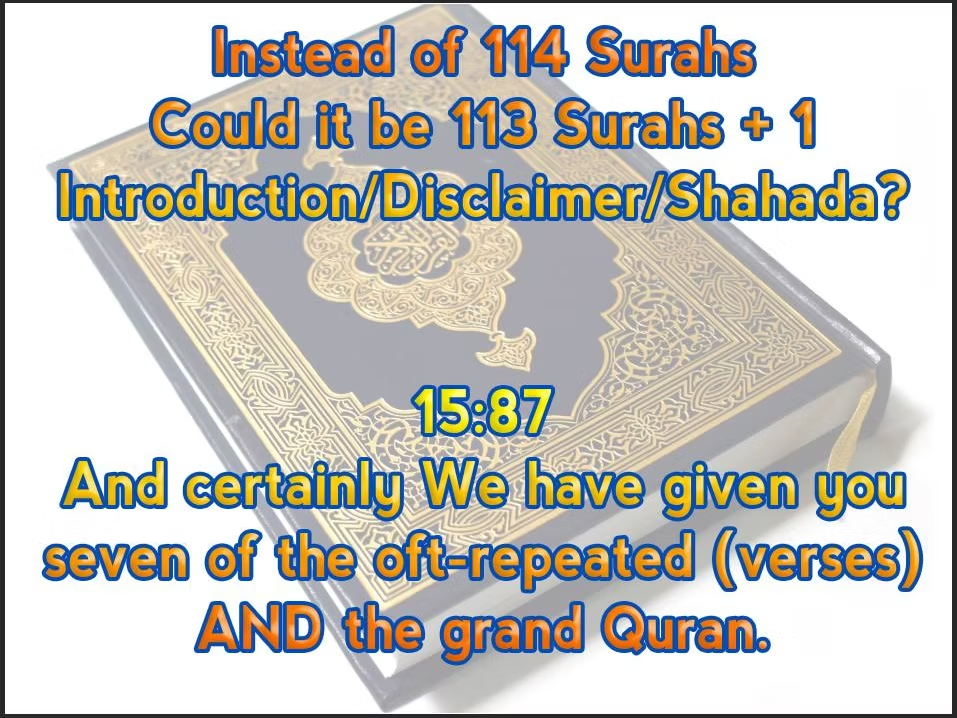
Instead of 114 surahs, could it be 113 +1? 15:87 “And certainly we have given you seven of the oft repeated (verses) and the grand Quran.”
The Separation Between the Quran and Al-Fatihah
Disclaimer: It is acknowledged there are many possible ayat/s (verses) or surahs (chapters) 15:87 can be related to; however, for this article, I am taking it to be related to the one most obvious which is Al-Fatihah.
One of the intriguing aspects of the Quran is the distinction between Al-Fatihah and the rest of the Quran. The Quran itself explicitly acknowledges this division :
15:87 “And certainly We gave you the seven oft-repeated (verses) AND the Sublime Quran.”
This verse suggests a clear separation: Al-Fatihah, often referred to as “the seven oft-repeated” stands apart from “the Sublime Quran.”
If we take this distinction into account, then logically, Surah Al-Baqarah, currently the second Surah, should be considered the first. Al-Fatihah functions as an introduction, a prelude, or even a kind of “shahada” for the Quran rather than a direct informative discourse. It is a supplication, meant to be recited formally, regardless of one’s stance on traditional prayer.
Evidence Supporting This Structure
Is there textual evidence within the Quran to support this theory? Consider the following verse:
2:23 “And if you are in doubt about what We have sent down upon Our Servant, then produce a Surah the like thereof, and call upon your witnesses other than Allah, if you should be truthful.”
The phrase “produce a Surah” implies that this would be the first Surah in the structured order of the Quran. This would mean the verse traditionally labeled as 2:23 should actually be 1:23 in this revised framework. (BTW; for whatever it’s worth, our phone #s end with 3022 and 0321. 3/22 is the spring solstice which marks a new beginning, and 321 is like a countdown. So, we’ve always found these numbers interesting in “these times” which mark the end of the age of Pisces and the beginning of both Aquarius and the millennial reign we’re promised is coming.)
This pattern continues:
11:13 “Or do they say: ‘He has forged it’? Say: ‘Then bring ten forged Surahs like it and call upon whom you can besides Allah, if you are truthful.'”
Notice the numerical structure: the challenge to produce one Surah appears in what would be the first Surah (1:23), while the challenge to produce ten Surahs appears in what would be the tenth Surah (10:13). The symmetry is intriguing.
Numerical Patterns and Surah Al-Hadid (The Iron Chapter)
If this proposed structure is correct, Surah Al-Hadid (Iron), traditionally numbered as the 57th Surah, would instead be the 56th. This shift aligns with an astonishing scientific correlation:
-
The most abundant isotope of iron has a mass number of 56 (number of protons and neutrons).
-
The atomic number of iron (number of protons) is 26.
-
The word Al-Hadid appears in the 26th verse of a Surah that contains 30 verses.
A Mathematical Revelation
Beyond this, the exact position of the word Al-Hadid within the verse astonishingly aligns with the atomic mass of iron, 55.847:
The Quran is made up of chapters (surahs), which contain verses (ayahs), and each verse has words.
The chapter Al-Hadid (Iron) is numbered 56 (if counted the way we are here). Iron’s most common isotope has a mass number of 56—a curious match!
In this chapter, the word Al-Hadid appears in verse 26, and the atomic number of iron (number of protons) is also 26—another match!
But there’s something even more precise…
If we calculate the exact position of the word Al-Hadid in the Quran, it gives us 55.847, which is the atomic mass of iron!
Think of it Like a Bookshelf 📚
Imagine the Quran as a bookshelf with 114 books (surahs).
Each book has drawers (verses).
Each drawer has sheets of paper (words).
Now, let’s locate the word Al-Hadid:
Books: To reach the 56th book, you pass 55 full books → 55
Drawers: The word is in verse 26. Since this chapter has 30 verses, we go 25 full drawers (verses) out of 30 → 25/30
Sheets: The word is the 13th word in a 28-word verse. So, we count 12 sheets out of 28. Since a drawer is 1/30th of a book, this gives 12/28 × 1/30
Now, we sum it up:
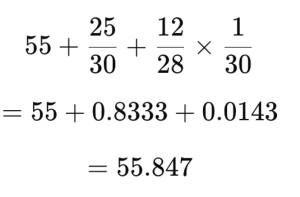
See #26, Fe/Iron 55.847
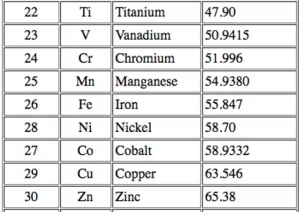
End.
We (David and Peggy) recently purchased a couple of “Iron Flask” brand stainless steel cups. Just after having added the above graphics to the end of this post (originally copied from https://www.organisedquran.com/113-1-surahs-or-114-surahs) I realized mine was sitting just to the left of the keyboard (without the spare lid) facing me like so!
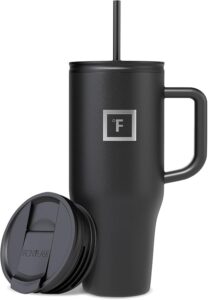
The mathematical, scientific and literary genius being found in many of the authentic scriptures, especially the Quran, and these other sorts of “mini-miracles” as noted above with 322, 321 and the one just shown, are really only explainable in a computer like “Simulation Creation”.